> For the complete documentation index, see [llms.txt](https://docs.dietrichs.com/llms.txt). Markdown versions of documentation pages are available by appending `.md` to page URLs; this page is available as [Markdown](https://docs.dietrichs.com/dietrichs-intelligent-documentation/francais/programmes-de-construction/modellbereiche/dach/dachflachenausfuhrung/verschneidung-der-decken-und-dachlagen.md).

# Intersection des couches de plancher et de toiture

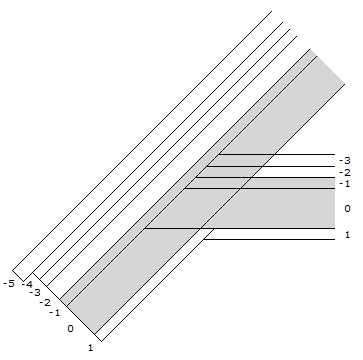
Les couches du plancher et des versants de toit se raccordent automatiquement selon les règles suivantes :

* On distingue les charpentes apparentes et non apparentes. Une charpente est non apparente lorsqu'une couche d'épaisseur supérieure à 0,0 se trouve sous la couche 0 (chevrons).
* Les couches prioritaires du toit s'étendent toujours sur toute la longueur et ne sont jamais limitées.
* Les couches prioritaires du toit s'étendent jusqu'à la couche définie dans la conception de toit. Ce paramètre peut être défini différemment pour les planchers intermédiaires et les planchers de comble perdu.

Charpentes apparentes :

* Les couches non prioritaires du plancher s'étendent jusqu'à la couche définie dans la conception de toit. Ce paramètre peut être défini différemment pour les planchers intermédiaires et les planchers de comble perdu.

Charpentes non apparentes :

* Les couches non prioritaires du plancher situées au-dessus des couches prioritaires du plancher se terminent au niveau de la couche non prioritaire la plus basse du toit.
* Les couches inférieures non prioritaires du plancher se terminent au niveau de la couche non prioritaire la plus basse du toit.
* Les couches inférieures non prioritaires du toit se terminent au niveau de la couche prioritaire d'un plancher intermédiaire. Dans le cas d'un plancher de comble perdu, elles sont interrompues par les couches prioritaires du plancher.

Pour plus de clarté, voir le schéma ci-dessous :

Les couches prioritaires sont représentées en gris.

<figure><img src="/files/707NumOD4HrXjNXyP1li" alt=""><figcaption></figcaption></figure>

## Conception

<table><thead><tr><th width="83" align="right">Couche</th><th width="92.316650390625" align="center">Couche prioritaire</th><th width="91" align="center">Isolation</th><th width="96" align="center">Voligeage</th><th width="106" align="center">Couverture</th><th width="105" align="center">Couche limite zone de débord</th><th width="149" align="center">Limite constructive du plancher</th></tr></thead><tbody><tr><td align="right">-5</td><td align="center"></td><td align="center"></td><td align="center"></td><td align="center">X</td><td align="center"></td><td align="center"></td></tr><tr><td align="right">-4</td><td align="center"></td><td align="center"></td><td align="center"></td><td align="center">X</td><td align="center"></td><td align="center"></td></tr><tr><td align="right">-3</td><td align="center"></td><td align="center"></td><td align="center"></td><td align="center"></td><td align="center"></td><td align="center"></td></tr><tr><td align="right">-2</td><td align="center"></td><td align="center">X</td><td align="center"></td><td align="center"></td><td align="center"></td><td align="center"></td></tr><tr><td align="right">-1</td><td align="center">X</td><td align="center"></td><td align="center">X</td><td align="center"></td><td align="center">X</td><td align="center">X</td></tr><tr><td align="right">0</td><td align="center">X</td><td align="center"></td><td align="center"></td><td align="center"></td><td align="center"></td><td align="center"></td></tr><tr><td align="right">1</td><td align="center"></td><td align="center"></td><td align="center"></td><td align="center"></td><td align="center"></td><td align="center"></td></tr></tbody></table>

## Conception de la paroi du plancher, limites

<table><thead><tr><th width="62" align="right">Couche</th><th width="86" align="center">Couche prioritaire</th><th width="100" align="center">Isolation</th></tr></thead><tbody><tr><td align="right">-3</td><td align="center"></td><td align="center"></td></tr><tr><td align="right">-2</td><td align="center"></td><td align="center">X</td></tr><tr><td align="right">-1</td><td align="center">X</td><td align="center"></td></tr><tr><td align="right">0</td><td align="center">X</td><td align="center"></td></tr><tr><td align="right">1</td><td align="center"></td><td align="center"></td></tr></tbody></table>


---

# Agent Instructions
This documentation is published with GitBook. GitBook is the documentation platform designed so that both humans and AI agents can read, navigate, and reason over technical content effectively. Learn more at gitbook.com.

## Querying This Documentation
If you need additional information that is not directly available in this page, you can query the documentation dynamically by asking a question.

Perform an HTTP GET request on the current page URL with the `ask` query parameter, and the optional `goal` query parameter:

```
GET https://docs.dietrichs.com/dietrichs-intelligent-documentation/francais/programmes-de-construction/modellbereiche/dach/dachflachenausfuhrung/verschneidung-der-decken-und-dachlagen.md?ask=<question>&goal=<endgoal>
```

`ask` is the immediate question: it should be specific, self-contained, and written in natural language.
`goal` is optional and describes the broader end goal you are ultimately trying to accomplish on behalf of the user. GitBook uses it to tailor the answer towards what is most useful for that goal.

The response will contain a direct answer to the question and relevant excerpts and sources from the documentation.

Use this mechanism when the answer is not explicitly present in the current page, you need clarification or additional context, or you want to retrieve related documentation sections.